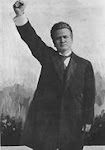
Labor is prior to and independent of capital. Capital is only the fruit of labor, and could never have existed if labor had not first existed. Labor is the superior of capital, and deserves much the higher consideration.
Elizabeth DiNovella, who had been
covering CPAC (Conservatives Planning Absolute Corporatism) and writing about it at Dane 101, also gutted it out by
listening to Scott Walker's address to the convention. In her piece, she quoted Walker's take on collective bargaining:
“Collective bargaining is not a right. Collective bargaining in the public sector is an expensive entitlement,” he said. This line got the biggest applause of the night.
When I read that, I damn near did a spit take on my monitor.
There is so much wrong with that short blurb that it will never be right.
Collective bargaining is a right, and that right might very well be extended into the public sector, as I wrote about
nearly a year ago:
The ruling by U.S. District Judge Ronald Guzman affirms that collective bargaining rights cannot be overturned by governmental edict. Guzman told the Legislature “it had no business trying to interfere with collective bargaining” according to Marvin Gittler, an attorney representing Local 727 of the Teamsters.
Guzman held that the National Labor Relations Act preempts the Legislature from dictating terms for unions working at McCormick Place. This ruling is similar to the finding of The International Commission for Labor Rights, which has said, in part: The ICLR identified the right of "freedom of association" as a fundamental right and affirmed that the right to collective bargaining is an essential element of freedom of association. These rights, which have been recognized worldwide, provide a brake on unchecked corporate or state power.
Now, before anyone points out that the NLRA is for private sector unions, read on:
While the NLRA covered US employees in private employment, the law protecting collective bargaining in both the public and private sectors has developed since 1935 to cover all workers "without distinction."
The other problem with Walker's false statement is what he is calling an "expensive entitlement." He's saying that the people of Wisconsin
no longer should be afforded things like weekends off, not having their kids working in sweat shops, eight hour work days, forty hour work weeks, holidays off, living wages, vacations, equality in the work place or safe working conditions.
In other words, he wants to weaken the unions, both private and public, to help maximize the profits of the corporate interests who have been funding his campaigns and who, he hopes, will buy him the Presidency of the United States.

But it doesn't end there, gentle reader.
Walker has also been bantering about the phrase "legacy costs," which is something he started in Milwaukee County, with the aid of the plutocrats at the Greater Milwaukee Committee, an old boys (and girls) club for Milwaukee's wealthiest people, who see Milwaukee has their toy thing.
By "legacy costs," Walker is speaking about health care insurance and pensions.
Health care costs are through the roof, especially in Southeast Wisconsin, which has one of the highest rates, if not the highest, in the nation. And workers should carry their fair share of the costs. But when CEOs of insurance companies and health care agencies are getting compensated in the millions of dollars, there is an obvious problem which needs to be addressed.
Of course, it is Walker and his ilk that are opposed to fixing the system. Guess who are big donors to their campaigns.
It should be noted that Walker, if the reader will remember, was swept in as Milwaukee County Executive on the heels of a pension scandal enacted by his predecessor, Tom Ament. The gist of the scandal is that it provided a super enhancer to the pension of people that had been with the county for a long time. It also included a generous backdrop that would allow retirees to take a large lump sum at the time of retirement and a smaller monthly pension payment. Some county employees walked away with a million dollars when they retired. Ironically, most of these big money beneficiaries were non-represented employees. That means Walker could have stopped it at any time, but chose not to.
But of course he didn't want to stop these payments. One, it was a great political hammer to wield. Every time Walker was caught with a budget problem (which he usually contrived), he'd just blame the pension scandal, regardless of how long ago it was. Secondly, he was appointing most of his cronies to these positions and wanted to make sure they were rewarded. (Here's food for thought, Darlene Wink, who was convicted of only
misdemeanors, is eligible for her pension.)
Oddly, the pension fund, pre-Walker was sufficient that it could have covered the enhanced pension pay outs. However, the two recessions during the Bush/Cheney administration took a big bite out of it, like it did for most people. Unlike the people that had 401(k)s, the public sector had their pensions protected for the most part.
In spite of the need for Milwaukee County to contribute to the pension fund for the first time in years, Walker, as county executive, chose to short change what the county owed to the fund and instead use it to reward campaign donors with sweetheart contracts. By shorting the payments to the fund, Walker only exacerbated the situation. It would be much akin to not making the minimum payment on a credit card. Not only do you still owe the balance, and the next payment, they add on fees and interest to make the next payment exponentially bigger.
To deal with this self-constructed problem, Walker tried to get a pension obligation plan pushed through. The wheeler and dealer behind this plan was a man name Nick Hurtgen, a GOP operative who eventually got busted himself in a kickback scheme. Fortunately, the County Board preempted Walker's move by making it a referendum question which the voters killed.
Walker did give Hurtgen a
$300,000 contract to restructure the county's debt. In return, Hurtgen gave Walker a $25,000 campaign fundraiser.
Now Walker wants to convert the state's pension system, which is a defined benefit system and is fully funded and in good shape per all reports, into a defined contribution system. (They are looking at trying to do the same thing
in Milwaukee County, even though there is no proven need for it.)
This is, as you might suspect, preposterous.
First of all, as I mentioned above, the pension system is fully funded and not a problem for tax payers.
Secondly, Walker can't complain about expenses, since his forcing public sector workers to "pay more" for their pensions is nothing more than a scam, since public sector workers are
already paying 100% into their pensions:
Out of every dollar that funds Wisconsin' s pension and health insurance plans for state workers, 100 cents comes from the state workers.
How can that be? Because the "contributions" consist of money that employees chose to take as deferred wages – as pensions when they retire – rather than take immediately in cash. The same is true with the health care plan. If this were not so a serious crime would be taking place, the gift of public funds rather than payment for services.
Thus, state workers are not being asked to simply "contribute more" to Wisconsin' s retirement system (or as the argument goes, "pay their fair share" of retirement costs as do employees in Wisconsin' s private sector who still have pensions and health insurance). They are being asked to accept a cut in their salaries so that the state of Wisconsin can use the money to fill the hole left by tax cuts and reduced audits of corporations in Wisconsin.
By implementing Act 10, Walker is docking the workers' paychecks, because he can, and diverting the money.
But that diversion isn't enough for him or his campaign contributors. They want more. Hence the idea of converting, or fixing, the system, even though it's not broke or broken.
But while it might be sound like a good plan to your average squawk show listener,
the reality is that it would not only stick it to the workers, but also to the taxpayers:
And governments are concerned about delivering on the promises that they have made to their citizens and to their employees as tax revenues shrink amid a weakening economy. In this environment, some have proposed replacing traditional defined benefit (DB) pensions with 401(k)-type defined contribution (DC) retirement savings plans in an effort to save money.
But decision-makers would be wise to look before they leap. To deliver the same level of retirement benefits, a DB plan can do the job at almost half the cost of a DC plan. Hence, DB plans should remain an integral part of retirement income security in an increasingly uncertain world because they offer employers and employees the best bang for the buck.
So why do it if it's not good for anyone? Well, it does benefit the fat cats on Wall Street, who in turn, reward Walker for being a good employee for them.
The real kicker of this is, as I just pointed out with the above cited passage, is that if Walker gets his way, it's going to really stick it to the people of Wisconsin. Why? Well, in Walker's own words,
in sworn testimony given before a Congressional committee:
After an unresponsive answer by Governor Walker, Kucinich pressed, “Did you answer the questions? How much money does it save, Governor?”
“It doesn’t save any,” admitted Governor Walker.
Kucinich then requested permission to enter into the record a letter from the State of Wisconsin’s Legislative Fiscal Bureau (page 3 specifically), a nonpartisan state budget agency that confirmed Governor Walker’s efforts had no effect on the state’s budget.
“The Bureau was asked to identify provisions in the Governor’s bill that are non-fiscal; non-fiscal policy items that have no state fiscal effect. This letter confirms the obvious; that Governor Walker’s effort to repeal the rights of state workers is a non-fiscal policy item. No effect on the state budget shortfall,” said Kucinich.
The only expensive entitlements involved here are the ones that Walker wants to take with our money so that he may give it to his campaign contributors and cronies.